Leaking urine after prostate surgery is one of the things patients worry about most. It is also one of the things that responds best to a simple routine done consistently.
That routine is pelvic floor exercises, also known as Kegel exercises. You can do them anywhere, you need no equipment and they cost nothing. The trouble is that most people do them wrongly, and done wrongly they are of no use.
This guide covers how to find the right muscle, how to train it and the mistakes to avoid.
Why the leaks happen
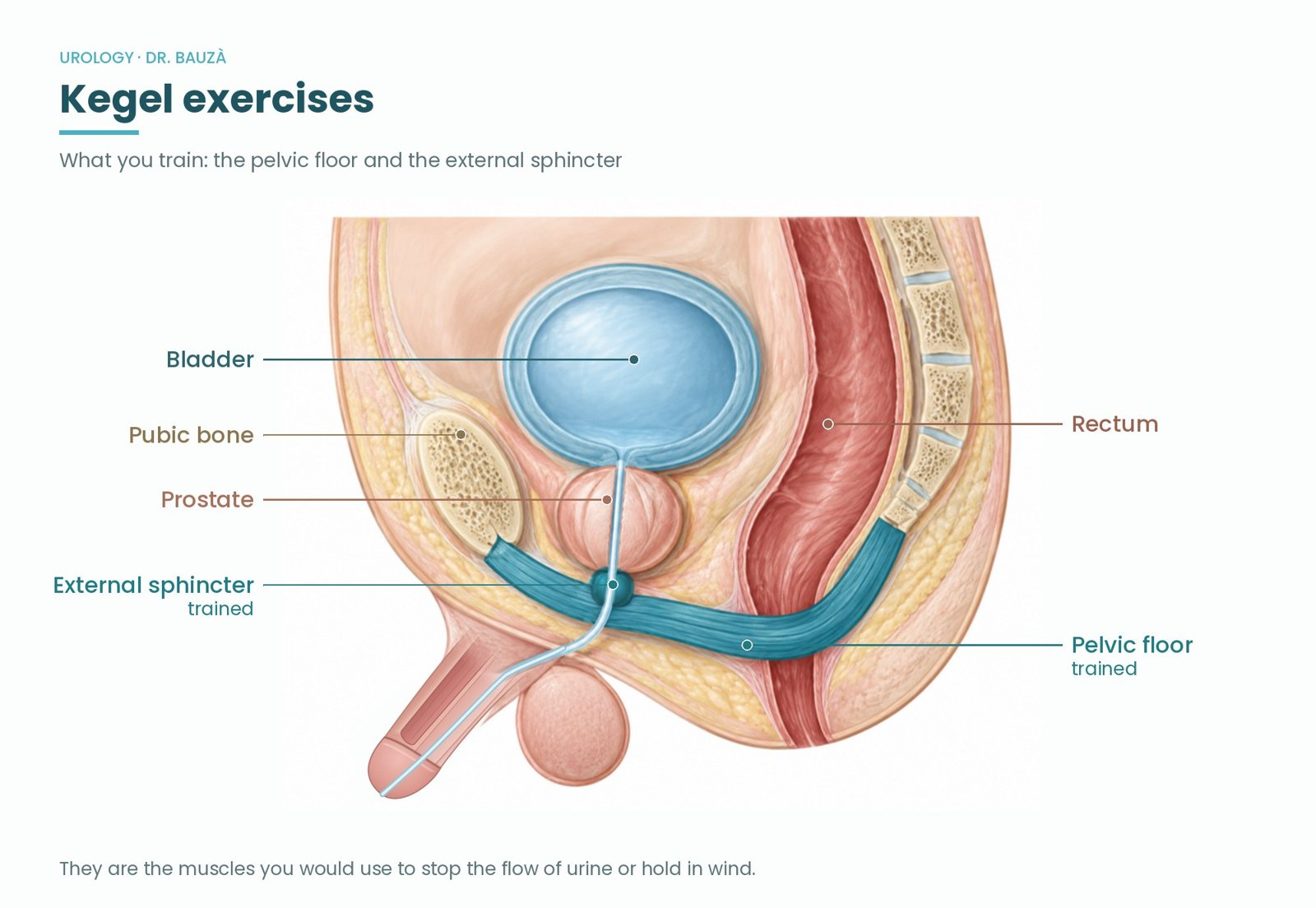
Two mechanisms keep urine in. One is in the area of the prostate. The other is the external sphincter, a muscle that is part of the pelvic floor and, unlike the first, one you can train yourself.
When a prostate that has been blocking the outlet for years is operated on, that balance changes overnight. On top of that, the bladder has got used to squeezing hard to push past the blockage, and it does not stop doing so the day after surgery. The result is the urgency and the leaks of the first few weeks.
Training the pelvic floor helps you regain control while everything else readjusts.
How to find the right muscle
This is the step people most often skip, and if it is not done properly, the rest will not work.
The pelvic floor muscle is the one you would use to:
Stop the flow of urine midstream.
Stop yourself passing wind.
Try this once, just to identify it. When you tighten it correctly, you will feel a squeeze and a lift in the area between your testicles and your back passage. If you stand in front of a mirror, you will see the base of the penis draw in slightly.
Important: stopping the flow to find the muscle is a one-off test, not an exercise. Do not make a habit of stopping the flow as a way of exercising, because it interferes with normal emptying of the bladder.
The routine
Once you have found the muscle:
Tighten your pelvic floor and hold it for 5 seconds.
Relax it completely for 5 seconds. The rest matters as much as the squeeze: a muscle that does not relax does not get stronger.
Repeat 10 times. That is one set.
Do 3 sets a day.
You can do them lying down, sitting or standing. At first it is easier lying down, because gravity is not working against you. As your control improves, move on to doing them sitting and then standing, which is when you will really need them.
Once you have mastered that, add quick squeezes: tighten and let go within one second, ten times in a row. These are the ones you use in everyday life, just before you cough, sneeze or lift something.
The four most common mistakes
1. Tightening your stomach, buttocks or thighs. This is the most common mistake. If your stomach tenses or your buttocks lift when you do the exercise, you are not working the right muscle. Put a hand on your stomach: it should stay relaxed.
2. Holding your breath. Breathe normally throughout the exercise. If you cannot talk while doing it, you are squeezing too hard.
3. Doing lots of them badly. Three sets done properly are worth more than two hundred rushed squeezes. Brute force does not come into it.
4. Giving up after two weeks. It is a muscle, and like any muscle it needs regular work. Progress is gradual and not always steady: you may have better days and worse days.
When to start
Once the catheter has been removed. Do not do them while the catheter is in.
From then on, keep doing them regularly over the following weeks, even when you feel things are going well. Many patients stop as soon as they improve and then notice a setback.
What else helps in the meantime
Drink water normally. Drinking less to leak less is a common mistake: it concentrates the urine, irritates the bladder and makes urgency worse.
Cut down on coffee, alcohol and fizzy drinks during this phase. They irritate the bladder and increase urgency.
Avoid constipation. A full bowel presses directly on the bladder and the pelvic floor.
Go to the toilet when you need to, not ‘just in case’: getting your bladder used to emptying when it holds only a little reduces its capacity and makes urgency worse.
When to get it checked
Book an appointment if:
The leaks are not improving, or are getting worse, as the weeks go by.
You cannot find the muscle, or you are not sure you are doing the exercise properly.
The leaks are affecting your daily life and you would like to look at other options.
There is more that can be done beyond the exercises, such as specialist pelvic floor physiotherapy, and it is worth looking into these options rather than just putting up with the leaks.
Key points
Find the right muscle before you start: it is the step people most often skip.
Squeeze for 5 seconds, relax for 5, repeat 10 times, 3 times a day.
Do not tighten your stomach, buttocks or thighs, and breathe normally.
Start once the catheter has been removed, never before, and keep at it.
Do not drink less water to leak less: it backfires.
If you are recovering from prostate surgery and the leaks are not improving as you expected, it is worth having them assessed. I see patients in Palma (Quirónsalud Palmaplanas) and in Manacor (Més Consultes Mèdiques).
Dr José Luis Bauzá Quetglas Urologist. Registered with the Balearic Medical Association (COMIB), no. 070709805. Palma — +34 971 918 000 · Manacor — +34 971 559 000 info@urologodrbauza.com
This article is general information and does not replace a medical consultation. Every case needs to be assessed individually.