
Andrology: vasectomy, erectile dysfunction, Peyronie’s disease and male infertility
Andrology deals with men’s sexual and reproductive health. Problems in this area are very common, yet embarrassment makes many men put off seeing a doctor for years. They are perfectly normal things to see a urologist about, they can be treated and, in some cases, they are the first sign of a different health problem.
No-scalpel vasectomy
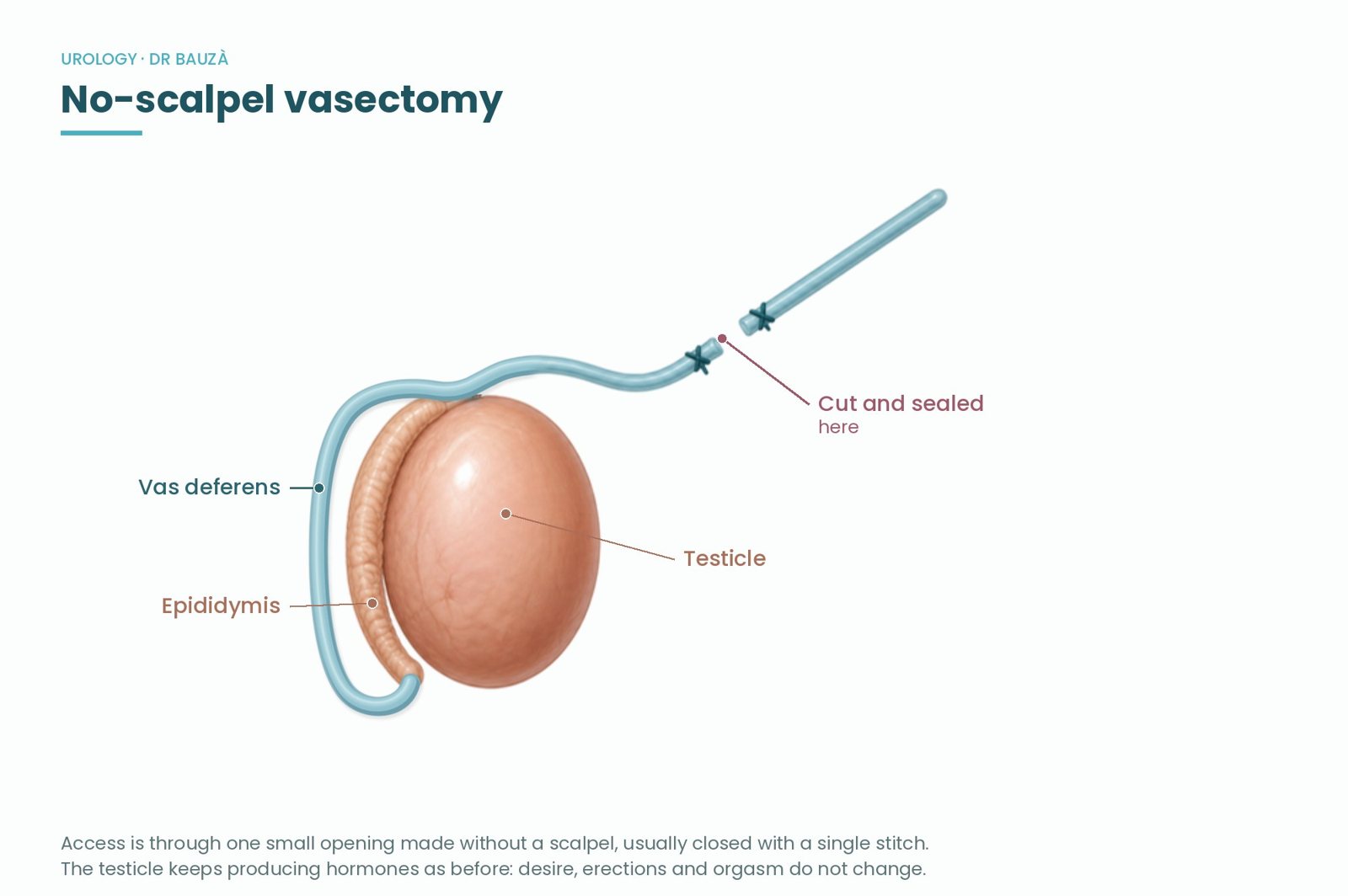
A vasectomy cuts the vas deferens, the tube that carries sperm from the testicle. The testicle goes on producing hormones and sperm as before: the only difference is that the sperm no longer reach the semen.
I perform no-scalpel vasectomy through a single opening. Instead of cutting the skin with a scalpel, the tube is reached through a tiny opening made with a blunt instrument, which parts the tissues rather than cutting them. Compared with the conventional technique, it is associated with less bleeding, fewer haematomas, fewer infections and less pain, and the skin is usually closed with a single stitch.
- A day case, under local anaesthetic. You go home the same day.
- It should be thought of as permanent. Reversal surgery exists, but it is more complex, does not always work and should not be counted on when you decide.
- It does not work straight away. It takes a few weeks, and a follow-up semen analysis has to confirm that there are no sperm left. Until then you need to keep using another method of contraception.
- It does not affect erections, sex drive or orgasm, and the amount of semen barely changes: sperm make up only a tiny part of the volume.
Erectile dysfunction
Erectile dysfunction means ongoing difficulty getting or keeping an erection firm enough for sex. A one-off episode, when you are tired, stressed or have been drinking, is not erectile dysfunction.
The most important thing I can tell you is this: erections depend on the blood vessels, and erectile dysfunction is often the first warning of a problem with the circulation. It can come years before high blood pressure, diabetes or cardiovascular disease. So getting it checked matters for more than your sex life: it is a chance to pick up something more serious in time.
The assessment usually includes your medical history (including any medicines you take, as quite a few of them can cause it), an examination and blood tests for sugar, cholesterol and, depending on the case, testosterone.
Treatment goes in steps: first getting risk factors under control and making lifestyle changes, which also improves the rest of your health; then medication; and if that is not enough, there are other options, which I can go through with you at your appointment, depending on your case.
Peyronie’s disease
A plaque of fibrous tissue forms in the sheath that covers the erectile tissue of the penis. Because that area does not stretch, the penis bends during an erection, and there may also be pain or shortening.
Two common worries are worth clearing up: it is not cancer, and it is not caused by anything you did wrong.
It has two phases, and which one you are in changes the decision. In the early, inflammatory phase there is pain and the curve may keep changing; surgery is generally not done at this stage, because the result would not be stable. Once the condition settles (the pain goes and the curve stops getting worse), that is the time to decide what to do, depending on how marked the curve is, whether it makes penetration difficult and whether there is also erectile dysfunction.
Male infertility
When a couple has been trying for a baby for about a year without success, it is worth looking into. And it is worth testing both partners at the same time: in roughly half of cases there is a male factor involved, on its own or together with a female one.
I say this because, in practice, the man tends to be tested late, after months of tests on the woman. That makes no sense: testing the man is simple, quick and not very invasive, and it can save a lot of time.
The assessment includes your medical history, an examination (which can pick up, for example, a varicocele, the most common correctable cause), a semen analysis (often repeated, because a single abnormal result is not conclusive), a hormone blood test and, depending on the case, an ultrasound scan.
From there, treatment depends on the cause: some problems can be corrected, others improved, and in some cases the right step is to go straight to assisted reproduction (such as IVF). What matters is knowing what we are dealing with before deciding.
Where I see patients
Clinics in Palma (Quirónsalud Palmaplanas) and Manacor (Més Consultes Mèdiques). You can call in English.
Appointments: +34 971 918 000 (Palma) · +34 971 559 000 (Manacor) · See addresses
Dr José Luis Bauzá Quetglas. Urologist. Registered with the Balearic Medical Association (COMIB), no. 070709805. Fellow of the European Board of Urology (FEBU). PhD in Medicine, University of the Balearic Islands (UIB).
This page is for information only and does not replace a medical consultation. Each case has to be assessed individually.