
HoLEP laser prostate surgery in Mallorca

HoLEP laser prostate surgery
Consultations in English and Spanish.
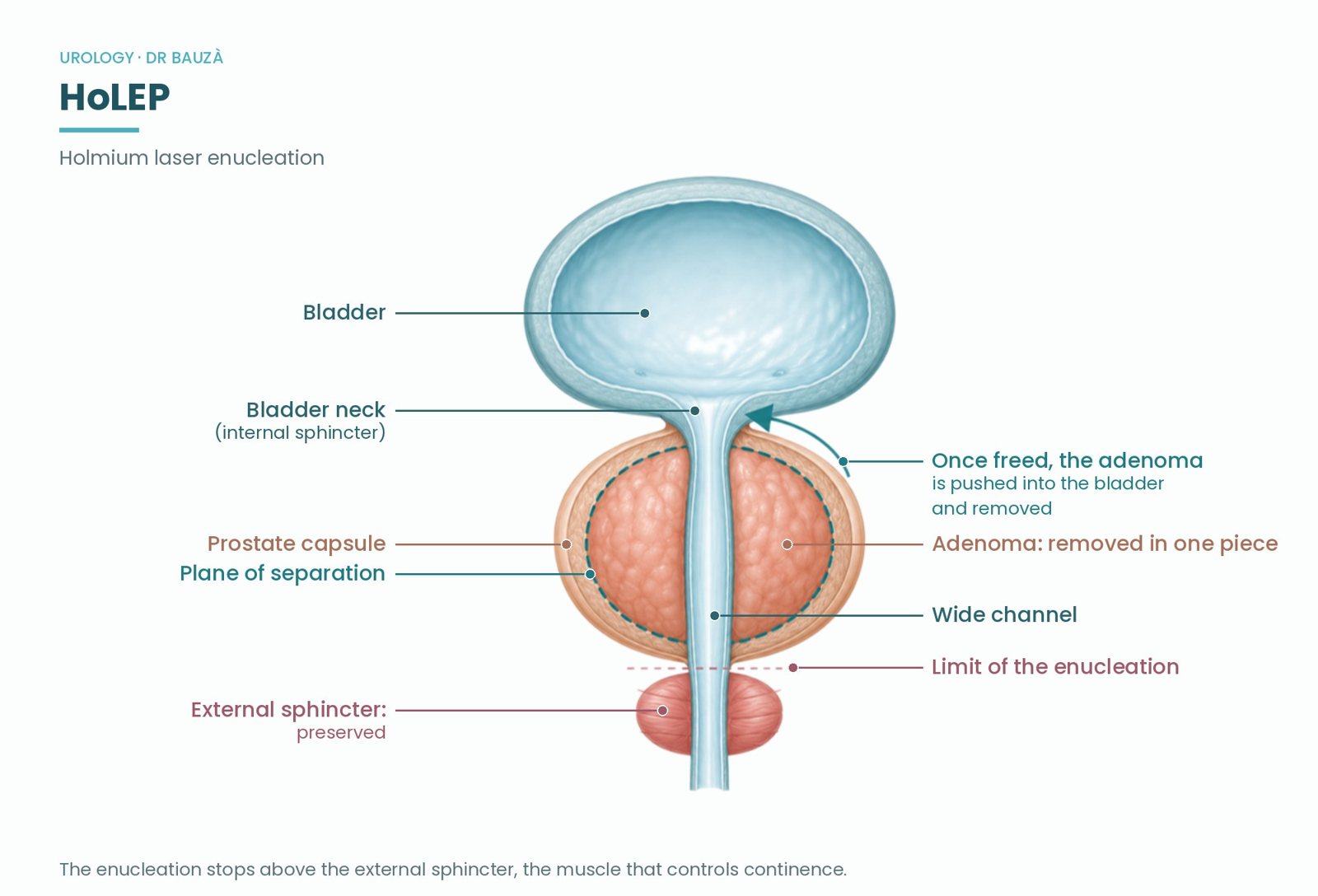
HoLEP (holmium laser enucleation of the prostate) is an operation for benign prostate enlargement (benign prostatic hyperplasia, or BPH), done through the urethra with no external incisions. Rather than vaporising the tissue, it frees the enlarged part of the prostate and removes it whole, as open surgery would, but without opening the abdomen.
Its key feature is that it works whatever the size of the prostate. In large prostates, where other endoscopic techniques fall short and open surgery used to be the only option, HoLEP allows the problem to be treated through the urethra.
On this page:
Why it happensWhen to operateHoLEPThe other techniquesBefore you decideWhere I see patientsBook an appointment
Why an enlarged prostate makes it hard to pass urine
The prostate surrounds the urethra just where it leaves the bladder. As it grows, it narrows that channel and urine meets resistance on the way out.
The bladder compensates by squeezing harder. It manages for years, which is why the symptoms come on gradually: the stream gets weaker, it takes longer to get going and to finish, and you are left feeling you haven’t quite emptied. Over time the bladder muscle thickens and becomes less elastic, and that is when urgency and getting up at night begin.
Size alone does not decide the treatment. Some large prostates cause hardly any symptoms, while some moderate ones cause a lot of obstruction. What I look at in clinic is how much your symptoms limit you and how well your bladder empties, rather than the weight in grams.
When is surgery considered?
- Urinary symptoms that do not improve with medication: a weak stream, difficulty getting started, a feeling of not emptying completely.
- Getting up several times at night to pass urine.
- Urinary retention, repeated infections or bleeding from the prostate.
- A large prostate.
- Preferring an operation to years of medication.
How HoLEP works
It is done in the operating theatre, under anaesthetic, with a short hospital stay. I go in through the urethra with an endoscope, so there are no cuts in the skin. Afterwards a catheter is left in place; it comes out before you go home or in the following days, depending on the case.
The tissue removed is sent for analysis, which is not the case with techniques that vaporise it.
What to know before you decide
Like most prostate operations, HoLEP can cause retrograde ejaculation: at orgasm, semen goes back into the bladder instead of coming out. It does not affect your health or your erections, but it is worth knowing about and talking through before surgery, because for some men it influences the decision.
It is also a technically demanding operation that requires specific training.
HoLEP is not the only option, and not always the best one
I also perform the other three usual techniques for benign prostate enlargement: Rezum, green laser and TURP. Being able to offer all four means the choice depends on your case (the size of your prostate, your symptoms, whether you take blood thinners, your priorities regarding sexual function) rather than on having only one technique available.
Before I suggest an operation, I assess your case: your history and symptoms, PSA, an examination and, where needed, an ultrasound scan to measure the prostate and see how well your bladder empties.
Where I see patients
Palma: Hospital Quirónsalud Palmaplanas, Camí dels Reis 308. Appointments and surgery.
Manacor: Més Consultes Mèdiques, Passeig del Ferrocarril 1, 1st floor. Appointments and follow-up; the operation itself is done at Palmaplanas.
Phone: +34 971 918 000 (Palma) · +34 971 559 000 (Manacor). Email: info@urologodrbauza.com
Your surgeon

Dr José Luis Bauzá Quetglas. Registered with the Balearic Medical Association (COMIB), no. 070709805. Specialist in urology (Son Espases University Hospital). PhD in Medicine, University of the Balearic Islands. Fellow of the European Board of Urology (FEBU). Professor Grases Award 2023 for the best doctoral thesis on urinary stones. More than 25 papers in indexed scientific journals.
Frequently asked questions
What size of prostate is HoLEP suitable for?
From about 30 grams, with no upper limit. That is what sets it apart from other endoscopic techniques.
How long will I have a catheter?
Between 24 and 48 hours in most cases.
How many nights in hospital?
One or two.
Is it normal to see blood in my urine in the first few days?
Yes. It is expected during the first few weeks and gradually settles. I explain this in detail in what to expect after the operation.
Is HoLEP always the best option?
No. Depending on the size of the prostate, your age and what matters most to you, Rezum, green laser or TURP may suit you better. That is why the first appointment is an assessment: the technique is not decided in advance.
Will my insurance cover the operation?
If your policy includes surgery and hospital admission, the operation can be done through your insurance. I work with Adeslas, Asisa, AXA, DKV, FIATC, Mapfre, MUSA and Sanitas, among others. At Quirónsalud Palmaplanas I also see patients with international health insurance. Your insurer has to authorise the operation before it is scheduled.
Book an appointment to have your prostate assessed
If you have been taking medication for years and still get up several times a night, or you have been told your prostate is too large to operate on through the urethra, the way to find out which technique suits you is to be assessed in person: an examination, a urine flow test and an ultrasound scan.
Appointments: +34 971 918 000 (Palma) · +34 971 559 000 (Manacor). You can call in English.
If you would rather be called back, leave your details in the form and write “prostate” or “HoLEP” as the reason.
This page is for information only and does not replace a medical consultation. Each case needs to be assessed individually.