
Kidney stones: shockwave lithotripsy and laser surgery
Kidney stones (urinary stone disease) are one of my two main areas of work, along with prostate surgery. The treatment depends on the size, hardness and position of the stone: shockwave lithotripsy, laser surgery through the natural urinary passages or percutaneous surgery. This page covers the first of these, which is the least invasive.
On this page:
How it worksWhen it is suitableWhen it is not the best optionThe sessionAfterwardsWhy the stone formed
Extracorporeal shockwave lithotripsy (ESWL) is the least invasive treatment there is for stones in the kidney and the ureter: it breaks the stone up from outside the body, with no incisions, no instruments inside the body and no hospital stay.
Stones were also the subject of my doctoral thesis, which won the Professor Grases Award in 2023.
How it works
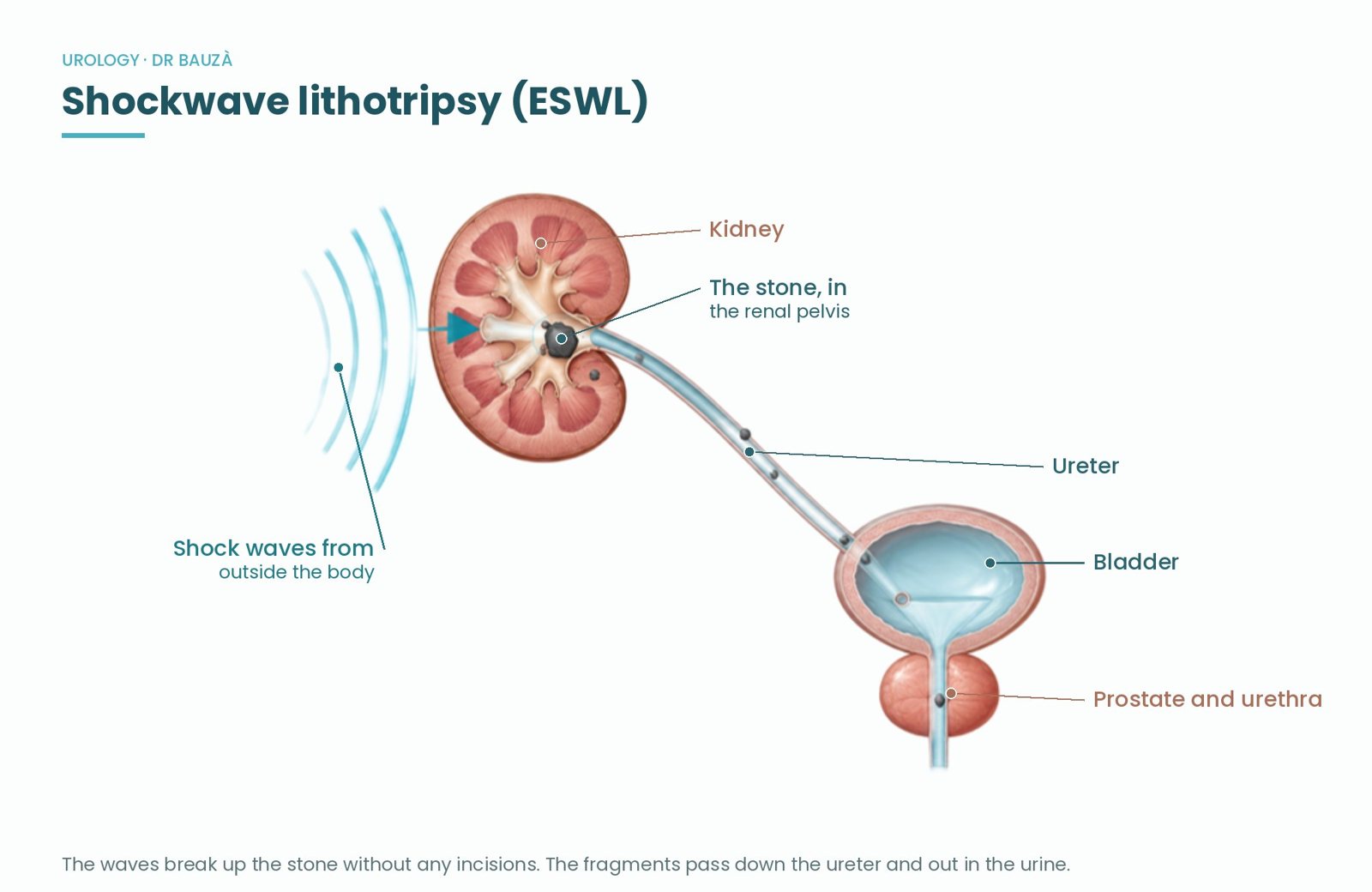
A machine produces shock waves outside the body and, guided by imaging, focuses them precisely on the stone. The energy gradually breaks it into small pieces, which you then pass naturally in your urine over the following days or weeks.
Put simply, the stone is broken up so that you can pass it yourself, rather than being taken out. That explains both its advantages and its limits.
When it is suitable
- Small or medium-sized kidney stones (as a rough guide, under 2 cm).
- Some stones in the ureter, depending on their size and position.
- Patients who would rather avoid a general anaesthetic and the operating theatre, when the stone allows it.
When it is not the best option
I prefer to be clear about this, because it is where most of the confusion lies:
- Large stones (over 2 cm) or very complex ones: percutaneous surgery or laser surgery works better.
- Very hard stones. Some types (cystine, calcium oxalate monohydrate, brushite) do not break up well with shock waves.
- Stones in the lower pole of the kidney above a certain size: even when they break up well, the fragments find it harder to drain out of that part of the kidney.
- A blockage below the stone, which would stop the fragments coming out.
- An active urine infection, pregnancy, an uncontrolled bleeding disorder, or blood thinners (anticoagulants) that have not been adjusted for the treatment.
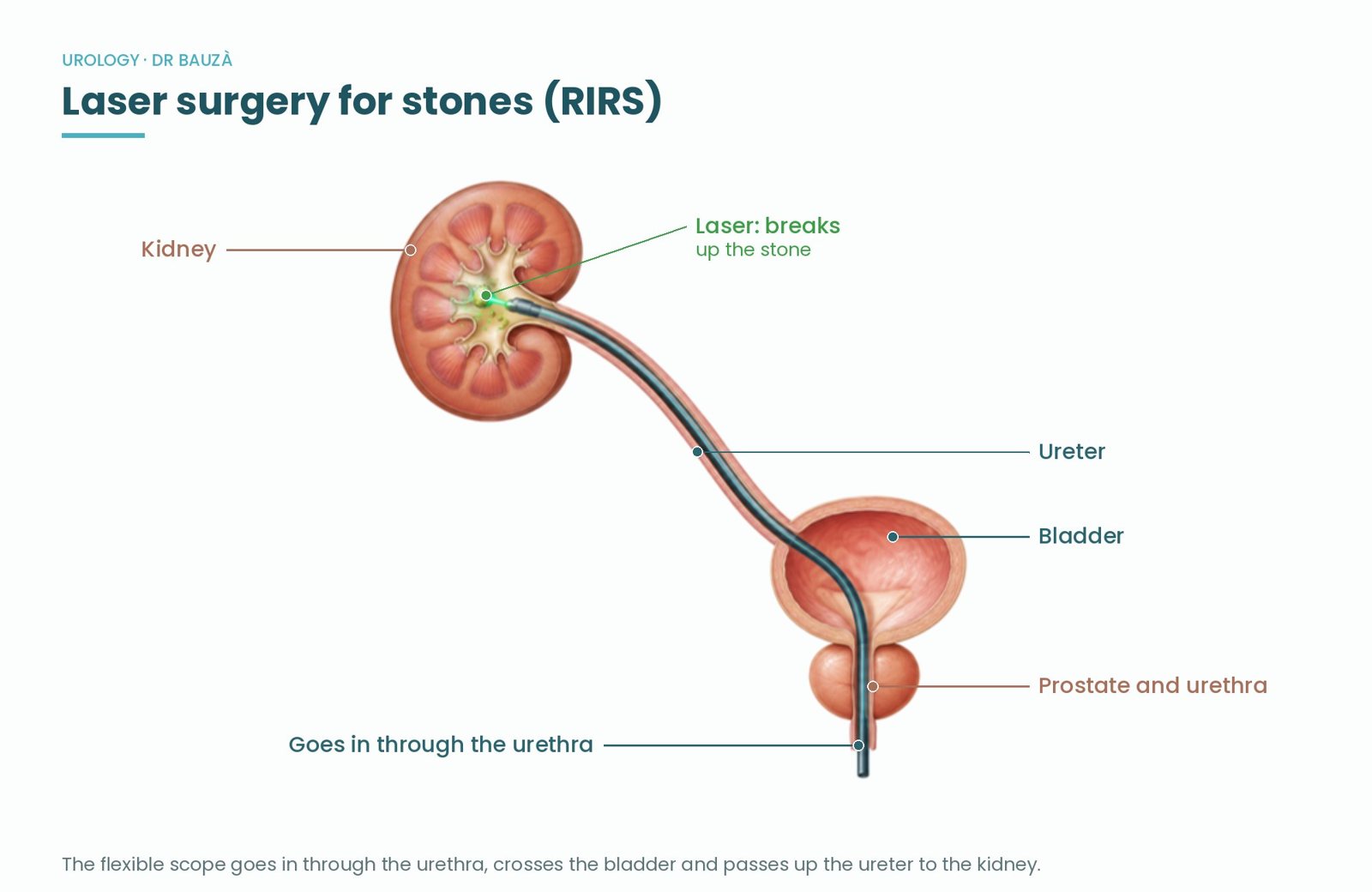
In those cases the usual choice is retrograde intrarenal surgery (RIRS): laser surgery through a flexible scope passed up the natural urinary passages, with no incisions. For bulky stones, percutaneous surgery (PCNL) is the other option. I go through it with you at your appointment, with your scan in front of us.
What the session involves
- A day case: you go home the same day, with no hospital stay.
- No incisions and no scopes. You lie down and the machine works from outside the body.
- Pain relief or light sedation, depending on the case; a general anaesthetic is not usually needed.
- Time: about an hour in all, including the treatment itself.
- You may need more than one session. This is normal and planned for: it depends on the size, hardness and position of the stone. It does not mean the first one has failed.
- A ureteric stent (JJ stent) is not usually needed beforehand. I only suggest one when a particular case calls for it.
After the session
- It is common to have an ache in your back or side and to see a little blood in your urine for the first few days. It is usually mild and soon passes.
- As the fragments come out you may get renal colic, sometimes more than once. I give you a pain relief plan and tell you what to do if it happens.
- Drinking plenty of water helps the fragments pass.
- I arrange a follow-up appointment to check with a scan that the stone has gone. A stone that breaks up but is not passed is still a problem.
When to get help straight away
Go to A&E (Urgencias) if you develop a high temperature or shivering, if the pain does not settle with the painkillers you have been prescribed, or if you stop passing urine. A blockage combined with an infection is a medical emergency.
Next: why the stone formed
Having had one stone is the main risk factor for having another. Breaking up the stone solves this episode, but it does nothing about the cause.
That is why, if you keep forming stones, I suggest finding out why: analysing what the stone is made of and running metabolic tests, so that the prevention advice you get is aimed at your case rather than being a handful of general tips. This is the part of the problem my doctoral thesis was about.
Where
I carry out lithotripsy at Hospital Quirónsalud Palmaplanas (Camí dels Reis, 308, Palma). Your first appointment and follow-up visits can be in Palma or in Manacor. You can call in English.
Appointments: +34 971 918 000 (Palma) · +34 971 559 000 (Manacor)
Dr José Luis Bauzá Quetglas. Urologist. Registered with the Balearic Medical Association (COMIB), no. 070709805. Fellow of the European Board of Urology (FEBU). PhD in Medicine, University of the Balearic Islands (UIB); doctoral thesis on urinary stones, Professor Grases Award 2023.
This page is for information only and does not replace a medical consultation. Whether a treatment is right for you has to be assessed individually.