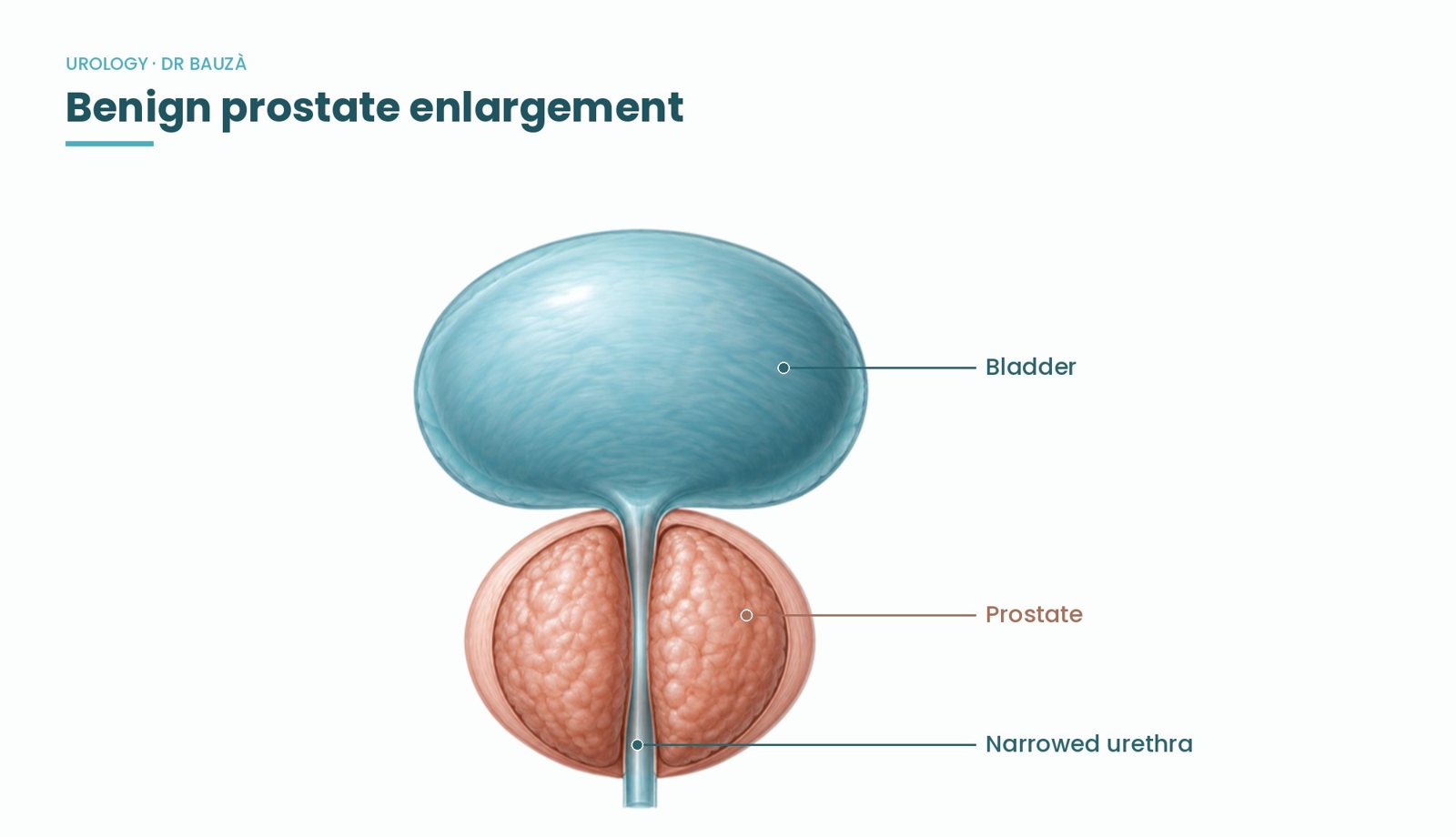
It is very common for the prostate to get bigger with age. This is called benign prostatic hyperplasia (BPH): a benign growth, not cancer. The size itself is not the issue. As it grows, the prostate can narrow the channel that urine passes through and cause symptoms that affect your daily life and your sleep.
The good news is that there is treatment for every situation, from medication to minimally invasive laser surgery, which has now replaced conventional surgery in most cases.
As it grows, the prostate squeezes the urethra, which is why passing urine becomes difficult.
Symptoms: what you notice
The symptoms of an enlarged prostate have to do with emptying the bladder and storing urine. The most common are:
A weak stream, or one that stops and starts.
Difficulty starting to pass urine.
A feeling that the bladder has not emptied completely.
Needing to go often, during the day as well.
Getting up several times at night to pass urine (nocturia).
Urgency: a sudden need to go that is hard to hold.
These symptoms come on gradually, and many men put them down to ‘just getting older’. They are worth getting checked, both for your quality of life and because other causes need to be ruled out and, in some cases, complications prevented.
When to get help without delay
An enlarged prostate can usually be managed without any rush, but some situations need more urgent attention:
Being unable to pass urine at all (acute urinary retention): this is an emergency.
Blood in the urine.
Repeated urine infections.
Things clearly getting worse despite treatment.
Diagnosis: understanding the problem before treating it
Not all urinary symptoms in men come from the prostate, and not every large prostate needs an operation. So before any treatment is suggested, an assessment is needed. It usually includes your medical history and symptoms, a PSA blood test, an examination and, depending on the case, an ultrasound scan to measure the prostate and see how well the bladder empties, and a urine flow test, which measures the stream objectively.
That assessment shows what is happening and allows a sound decision on whether treatment is needed and, if so, which technique to use.
Treatment options
The choice depends on the size of the prostate, how severe your symptoms are, how much they affect your life and your own preferences, including whether you want to preserve sexual function. These are the main options:
1. Medication
For mild or moderate symptoms, treatment usually starts with medicines that relax the prostate or reduce its size. They work well in many cases and can keep things under control for years. Surgery is considered when medication is not enough, when complications appear or when the patient prefers a more permanent solution.
2. Rezum (water vapour)
Rezum is a minimally invasive technique that treats the prostate with water vapour. It is done as a day case, and its main advantage is that it tends to preserve sexual function, including ejaculation, which other surgical techniques often affect. It is an option to consider for small to moderately sized prostates and for men for whom keeping ejaculation is a priority. The effect on symptoms builds up over the following weeks.
3. Green laser (photoselective vaporisation, PVP)
With the green laser, the excess prostate tissue is vaporised endoscopically, without incisions. One of its advantages is that it causes very little bleeding, which makes it especially useful for patients on blood thinners or at risk of bleeding, in whom other operations would be more delicate.
4. HoLEP (holmium laser enucleation)
HoLEP enucleates the obstructing prostate tissue, which means it separates it and takes it out, again endoscopically and with no external incisions. Its great advantage is that it works well whatever the size of the prostate, including large prostates that used to require open surgery. It is a demanding technique that needs specific training.
5. TURP (transurethral resection of the prostate)
Transurethral resection of the prostate has been the standard operation for decades and remains a valid, well-proven option, particularly for medium-sized prostates.
A frank word about ejaculation: several of the surgical techniques for the prostate can cause retrograde ejaculation (the semen goes back into the bladder instead of coming out). It does no harm to your health and many men do not mind it much, but it is worth knowing about and discussing before you decide, because it is one of the factors that can tip the choice towards one technique or another.
In short
An enlarged prostate is benign and very treatable. Three things matter: getting your symptoms checked instead of putting up with them, assessing the case properly before treating it, and choosing the technique according to the size of your prostate, your symptoms and your priorities, including sexual function.
If you have urinary symptoms and would like your case assessed, you can book an appointment. I see patients in Palma (Quirónsalud Palmaplanas) and in Manacor (Més Consultes Mèdiques).
Dr José Luis Bauzá Quetglas. Urologist. Registered with the Balearic Medical Association (COMIB), no. 070709805. Fellow of the European Board of Urology (FEBU). PhD in Medicine, University of the Balearic Islands (UIB). Special interest in endourology and minimally invasive prostate surgery.
This article is general information and does not replace a medical consultation. Every case needs to be assessed individually.